Recording available here.
Gravação disponível aqui.
English (Poruguese below)
Utility Driven Demand-Side Energy Efficiency: Which Market Structure Is More Effective?
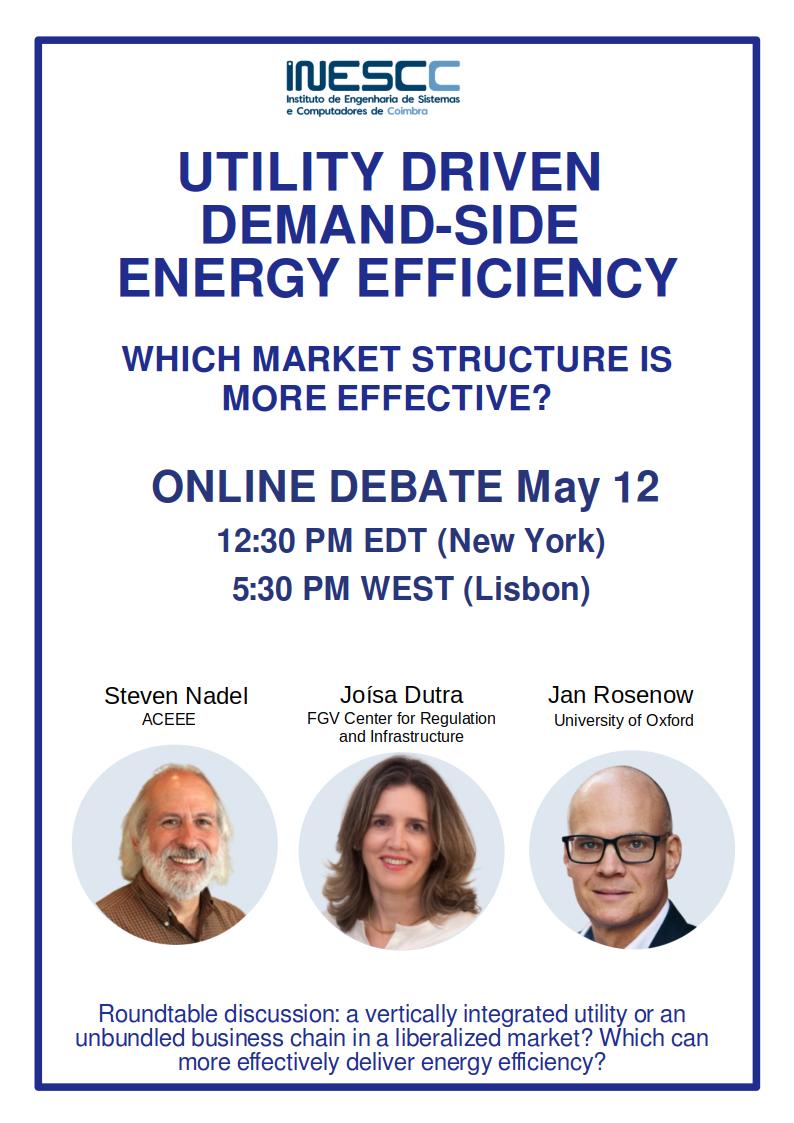
On May 12, a roundtable online discussion will debate the following topic: “Utility Driven Demand-Side Energy Efficiency: Which Market Structure Is More Effective?” There will be three qualified guests to share their views and to debate with the audience: Steve Nadel, a Senior Fellow and former Executive Director of ACEEE (American Council for an Energy Efficient Economy), and Joísa Dutra, a former Director at the Brazilian electricity regulator (ANEEL) who is currently a consultant, and Jan Rosenow, leader of the Energy Programme and Professor of Energy and Climate Policy at the Environmental Change Institute at the Oxford University.
Register at https://zoom.us/meeting/register/dKgF_gDURAq7st1gFyGyqA
“Strategic conservation” is one of the well-known six load diagram objectives of demand-side management (DSM). Under this goal, utilities carry out end-use energy efficiency programs in accordance with regulatory requirements and guidelines. DSM flourished, especially in the USA, in the 1980s and early 1990s, allegedly saving enormous amounts of money on avoided investments.
During the early phases of market liberalisation, most DSM programs were abolished under the guise of economic efficiency. This trend was eventually reversed in some way to address the long-term overall benefits of encouraging end-use energy efficiency.
However, the question remains: can liberalised markets really deliver energy efficiency as effectively as vertically integrated utilities?
Join us for a timely debate, as the energy transition requires democratic exchange of views, receptiveness to diverse perspectives, and the consideration of all viable options for a sustainable future.
——————————————–
Português
No dia 12 de maio, uma mesa-redonda online debaterá o tema: “Eficiência Energética do Lado da Procura Impulsionada pelos Concessionários: Qual a Estrutura de Mercado Mais Eficaz?” Três convidados qualificados irão partilhar as suas opiniões e debater com o público: Steve Nadel, membro sénior e ex-diretor executivo da ACEEE (American Council for an Energy Efficient Economy), Joísa Dutra, ex-diretora da Agência Nacional de Energia Elétrica (ANEEL) e atualmente consultora, e Jan Rosenow, líder do Programa de Energia e professor de Política Energética e Climática no Instituto de Alterações Ambientais da Universidade de Oxford.
Subscreva em https://zoom.us/meeting/register/dKgF_gDURAq7st1gFyGyqA
“Strategic conservation” é um dos bem conhecidos seis objetivos do Demand-side Management (DSM) relativos ao diagrama de carga. De acordo com este objetivo, as empresas elétricas implementam programas de eficiência energética na utilização final, em conformidade com requisitos e orientações regulatórias. O DSM floresceu, especialmente nos EUA, nas décadas de 1980 e início de 1990, alegadamente poupando enormes quantidades de dinheiro em investimentos evitados.
Durante as fases iniciais da liberalização do mercado, a maioria dos programas de DSM foi abolida sob o pretexto da eficiência económica. Esta tendência foi eventualmente corrigida de alguma forma para acautelar os benefícios gerais de longo prazo do incentivo à eficiência energética nas utilizações finais.
No entanto, a questão permanece: podem os mercados liberalizados realmente promover a eficiência energética tão eficazmente como as empresas verticalmente integradas?
Junte-se a nós para um debate oportuno – a transição energética exige uma troca democrática de opiniões, recetividade a diversas perspetivas e a consideração de todas as opções viáveis para um futuro sustentável.